Preliminary questions
1.
If you were
to drop a ball, releasing it from rest, what information would be needed to
predict how much time it would take for the ball to hit the floor? What
assumptions must you make?
2. If
the ball in Question 1 is traveling at a known horizontal velocity when it
starts to fall, explain how you would calculate how far it will travel horizontally
before it hits the ground.
3. When
an object passes through the Photogates, it blocks the passage of light from
one side to the other. The interface can accurately measure the duration of
time that the first gate is blocked until the second gate is blocked. If you
wanted to know the velocity of the object, what additional information would
you need?
Procedure
1. Set
up a low ramp made of angle molding on a table so that a ball can roll down the
ramp, across a short section of table, and off the table edge as shown in
Figure 1.
2. Position the
Photogates so the ball rolls completely through both gates while rolling on the
horizontal table surface (but not on
the ramp). Center the detection line of the gate on the middle of the ball.
Connect the Photogate to the Ch 1 To prevent accidental movement of the Photogate, you
can use tape to secure the ringstand in place. Use the link cable to connect
the TI Graphing Calculator to the interface. Firmly press in the cable ends.
3. Mark a
starting position on the ramp so that you can repeatedly roll the ball from the
same place. Roll the ball down the ramp through the Photogates. Stop the ball
before it leaves the table. Note: Do
not let the ball hit the floor during these trials, or during the following
velocity measurements. Make sure that the ball does not strike the side of the
Photogate. Move the Photogate if necessary.
4. Measure the
distance between the center’s of the Photogates as carefully as possible. The
accuracy of the rest of the experiment depends on this single measurement. You
must know the distance, Dx, in order to
calculate the velocity of the ball as it passes through the gates. You will
divide this distance by the time interval Dt measured by the interface to get the ball’s velocity (v = Ds/Dt). To successfully predict the impact
point, you must have an accurate
diameter measurement. Record the diameter in your Data Table.
5. Turn on the
calculator and start the program.
6. Observe the
reading on the calculator screen. Block the Photogate with your hand; note that
the Photogate is shown as blocked (--X--) on the calculator screen. Remove your
hand and the display should change to unblocked (--0--).
7. The calculator will
measure the length of time the photogate is blocked. You can see how this works
by the gate briefly with your hand. Prepare the calculator to do this.
a. Select
START from the main screen.
b. Block
the gate with your hand for about one second, and then remove your hand from
the gate.
8. Note that the calculator now shows a time
interval in seconds. This is the length of time that the gate was blocked.
Prepare the calculator to measure another interval.
a. Press  to end data collection.
b. Select
to
perform another time measurement.
9. Roll the ball from the mark on the ramp,
through the Photogate, and catch the ball immediately after it leaves the
table. Record each time interval in the Data Table. Repeat nine times. After
the last trial, press  to end data collection.
|
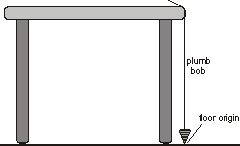
Figure 2
|
10. Inspect your time data. Did you get the same
value every time? From your time intervals and the ball diameter, determine the
velocity of the ball for each trial. Determine the average, maximum, and
minimum velocities, and enter them in your Data Table. What one value would be
most representative of all ten measurements?
11. Carefully measure the
distance from the tabletop to the floor and record it as the table height h in the Data Table. Use a plumb bob to
locate the point on the floor just beneath the point where the ball will leave
the table. Mark this point with tape; it will serve as your floor origin.
12. Use
your average velocity value to calculate the distance from the floor origin to
the impact point where the ball will hit the floor. You will need to
algebraically combine relationships for motion with constant acceleration
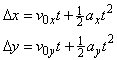
First, simplify the equations above. What is the
value of the initial velocity in the vertical direction (v0y)? What is
the acceleration in the horizontal direction (ax)? What is the acceleration in the vertical direction
(ay)? Remember that the
time the ball takes to fall is the same as the time the ball flies
horizontally. Use this information and the simplified equations to calculate
how far the ball should travel horizontally during the fall. Record the value
in your Data Table as the predicted impact point.
Mark your predicted impact point on the floor with
tape and position a target at the predicted impact point. Be sure the impact point
is along the line of the track.
13. To account for the variations you saw in the Photogate velocity
measurements, repeat the calculation in the preceding step for the minimum and
maximum velocity. These two additional points show the limits of impact range
that you might expect, considering the variation in your velocity measurement.
Mark these points on the floor as well, and record the values in your Data
Table.
14. After
your instructor gives you permission, release the ball from the marked starting
point, and let the ball roll off the table and onto the floor. Mark the point
of impact with tape. Measure the distance from the floor origin to the actual
impact and enter the distance in the Data Table.
Data Table
|
Trial
|
Time
|
Velocity
|
|
|
|
|
|
|
(s)
|
(m/s)
|
|
Ball diameter
|
|
m
|
|
1
|
|
|
|
Maximum velocity
|
|
m/s
|
|
2
|
|
|
|
Minimum velocity
|
|
m/s
|
|
3
|
|
|
|
Average velocity
|
|
m/s
|
|
4
|
|
|
|
Table height
|
|
m
|
|
5
|
|
|
|
Predicted impact point
|
|
m
|
|
6
|
|
|
|
Minimum impact point distance
|
|
m
|
|
7
|
|
|
|
Maximum impact point distance
|
|
m
|
|
8
|
|
|
|
Actual impact point distance
|
|
m
|
|
9
|
|
|
|
|
|
|
|
10
|
|
|
|
|
|
|
Analysis
1. Should
you expect any numerical prediction based on experimental measurements to be
exact? Would a range for the
prediction be more appropriate? Explain.
2. Was
your actual impact point between your minimum and maximum impact predictions?
If so, your prediction was successful.
3. You
accounted for variations in the velocity measurement in your range prediction.
Are there other measurements you used which affect the range prediction? What
are they?
4. Did
you account for air resistance in your prediction? If so, how? If not, how
would air resistance change the distance the ball flies?
Extensions
1. Derive
one equation for the horizontal and vertical coordinates of the ball’s motion
in this experiment.
2. Derive
a general formula for projectile motion with the object launched at an angle.
3. Increase
the challenge by placing a ring on a ring stand part way to the eventual
target. The ball must pass through the ring successfully and then hit the
target. You are required to position the ring as well as the target on the
floor.
4. (LabPro
only) Use a second Photogate to measure the speed of the ball. Instead of using
the ball diameter, measure the distance between the Photogates. Use the time
between blocks of the two gates to calculate the ball’s speed.
